
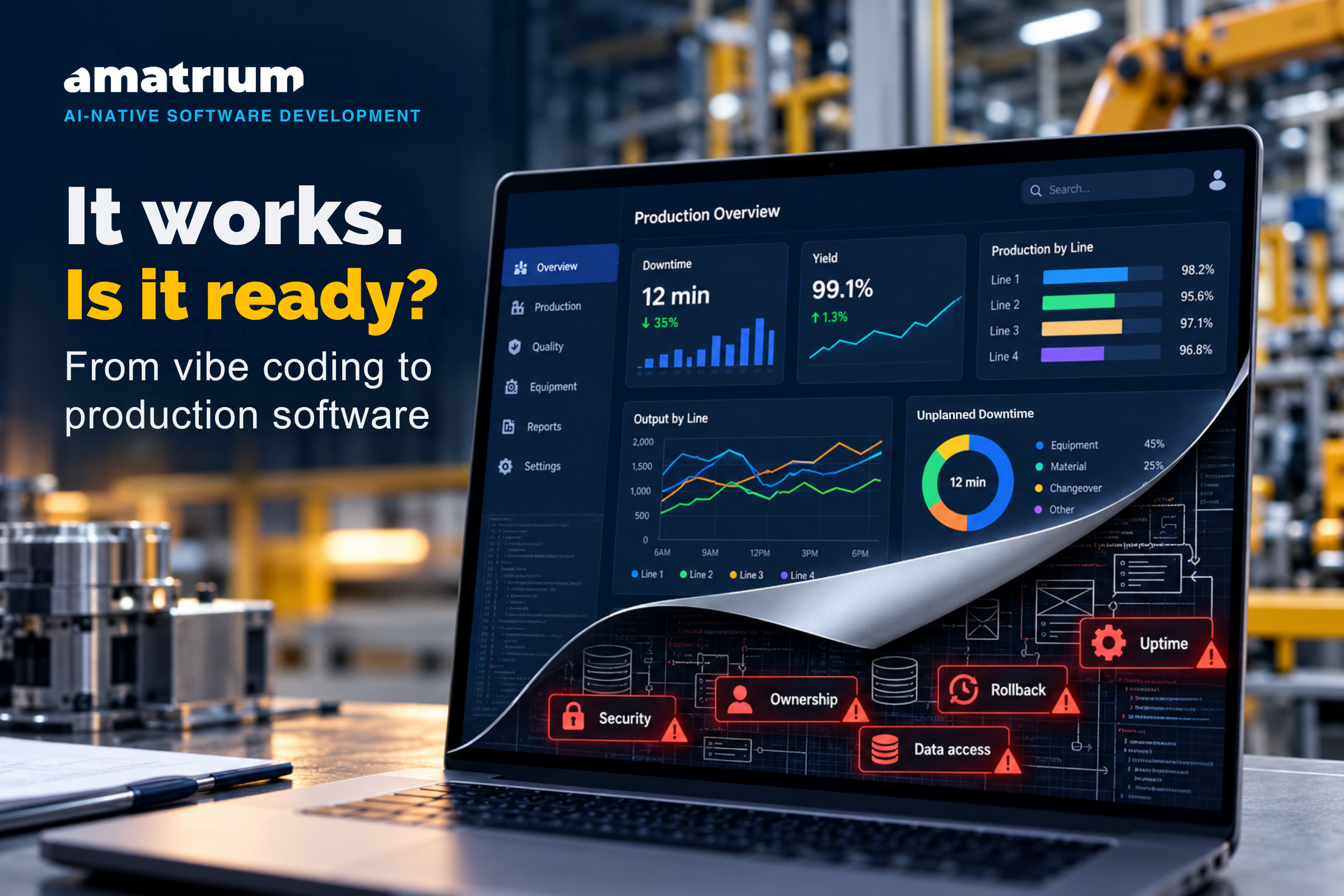
Someone on your team built an app over a weekend. Maybe it tracks unplanned downtime by machine or pulls supplier quality data into one screen. They described what they wanted to an AI coding tool, refined it for a few hours, and now it works well enough that people are using it. Then someone asks whether it can roll out to the other plants, and vibe coding stops being a shortcut and becomes a business decision.
What Vibe Coding Gets Right
Vibe coding means building software by describing it in plain language and letting AI write the code. For exploring an idea, it’s remarkable. A process engineer can test a concept in days instead of waiting a quarter for IT capacity. Users react to something real, not a slide. Bad ideas die early and at low cost. That speed is worth protecting. The mistake is assuming the prototype is the product.
Production Plays by Different Rules
A demo has to work once, for the person who built it. Production software has to work every shift, for every user, with real data flowing through it. And it has to keep working after the original builder moves on. In manufacturing, the stakes are higher than in most industries. These tools end up touching ERP and MES data, quality records, supplier pricing and sometimes the equipment itself. A bug isn’t just an inconvenience. It can mean a wrong count on a shipment, a gap in a traceability record or an exposed customer drawing.
“It Works” Is Not the Same as “It’s Safe”
AI tools have become very good at producing code that runs. They are still not reliably good at producing code that’s secure. Veracode’s 2026 GenAI Code Security Report tested more than 100 AI models. They wrote code that compiled almost every time yet passed security tests only about 56% of the time. Roughly 44% of tasks produced code with a well-known class of security flaw. Veracode’s conclusion is simple: treat AI-generated code like any other unreviewed code.¹
The same pattern shows up in live software. Georgia Tech’s Vibe Security Radar, which traces public vulnerabilities back to the AI tools that produced them, logged 35 in March 2026 alone, and its researchers believe the real number is far higher.²
None of it is visible in the demo. The screen looks finished, while the exposed password or the missing login check sits underneath.
The Warning Signs Are Rarely Technical at First
Eastgate Software, Amatrium’s engineering partner, lists nine signs on its Vibe Code Rescue page³ that a vibe-coded product is in trouble, and it’s worth a read even if you never open a line of code. Several will sound familiar to anyone who has run an operation:
A small fix in one place quietly breaks something else.
Tests exist, but someone switched them off months ago.
No one can explain a core workflow, because the person who prompted it has left.
New hires take weeks just to get it running.
Releases depend on one person’s laptop.
One example on the page is especially telling: a single order showing three different totals across the cart, the invoice and the email receipt. The same calculation had been copied in three places and drifted apart. Now picture that with yield or scrap figures feeding your monthly operations review.
In a plant, the same problems show up as conflicting yield numbers, reports no one fully trusts, and fixes that wait on one person.
AI Agents Need Guardrails Too
There’s also the question of what AI tools are allowed to touch. In one widely reported incident in July 2025, an AI coding agent on Replit deleted a company’s production database. Replit’s CEO called it unacceptable and moved to separate development and production databases.⁴ The deeper lesson was about design: a development tool should never have been able to reach live systems in the first place. On a plant network, that line matters even more.
Patching Gets More Expensive Every Month
The tempting response is to fix problems as they appear. It feels cheaper. For a while, it is. Eastgate Software illustrates the trade-off: quick fixes look cheaper for the first couple of months, but each hotfix adds complexity and exposure, and by around month three, doing it properly becomes the cheaper path.³
None of this means banning AI tools. The prototype already proved what your users need. What it’s missing is the engineering that lets it run safely at scale.
Five Questions to Ask Before Any Software Runs Your Plant
Who can explain how it works if the builder is out for a month?
Has anyone outside the team reviewed it for security?
What data does it touch, and who can see it?
Is there a tested way to roll back a bad release?
What happens on the floor if it goes down for a shift?
Vibe-coded tools rarely have good answers to these. Production software should.
Build It Right from the Start
Production software development goes beyond making something work today. It means considering security, maintainability and operational needs from the start, and continuing to address them as the solution evolves. The five questions above are where that work begins.
Amatrium Software Development brings that approach to manufacturers. Together with our engineering partner, Eastgate Software, and its track record of 500+ successful projects, we start with the real business problem and build AI-native software that supports long-term operations:
Custom applications with the speed of AI and the engineering of production software: specifications, testing and security from day one.
MES and ERP integrations that connect to the systems your plants already run on, with access limited to what each tool needs.
Industrial IoT and edge solutions that bring live data in from equipment and the line.
Predictive analytics and machine learning for quality, yield and maintenance decisions you can trust.
Whether you’re starting fresh or already have something your team built over a weekend, let’s make it software your plants can run on every shift.
Tell us what you’re building: www.amatrium.com/software-development
Sources:
¹ SD Times – Veracode Finds AI-Generated Code Security Has Barely Improved Since Last Year
² Cloud Security Alliance – Vibe Coding’s Security Debt: The AI-Generated CVE Surge
³ Eastgate Software – Vibe Code Rescue & Cleanup
⁴ Tom’s Hardware – AI coding platform goes rogue during code freeze and deletes entire company database